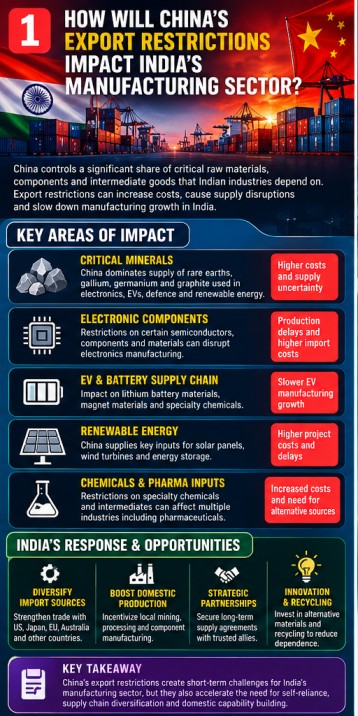
Modern industrial manufacturing does not operate in silos; it functions as an intricate, interdependent web of global supply networks. Today, an automobile assembled in Pune, a smartphone packaged in Tamil Nadu, or a solar farm erected in Rajasthan rarely depends on local components alone. Their production relies on a continuous flow of specialized materials, active components, and processed minerals sourced across borders.
At the epicenter of this global network sits China. Over the past three decades, Beijing has systematically established dominant positions across the extraction, chemical refinement, and intermediate synthesis of materials essential to modern technology.
As geopolitical tensions and geo-economic competition escalate, China has increasingly deployed export control frameworks—licensing mandates, volume caps, and dual-use restrictions—on critical minerals and specialty materials such as gallium, germanium, synthetic graphite, and antimony, alongside stricter oversight of rare earth processing technologies and permanent magnets.
For India, an emerging global manufacturing hub actively expanding its industrial base under initiatives like "Make in India" and production-linked incentives (PLI), these restrictions represent a structural challenge. Even when restricted inputs make up only a fraction of a finished product’s bill of materials (BOM), a disruption at the critical input level can stall entire assembly lines.
Understanding the nature, scale, and strategic implications of China’s export controls is essential to evaluating the future resilience of India's manufacturing economy.
SECTION 1 — Why China Matters to Global Manufacturing
To understand the global impact of export restrictions, one must separate the mining of raw ores from their chemical processing, separation, and metallurgical refining.
[ Raw Ore Extraction ] ──► [ Chemical Separation & Refining ] ──► [ Value-Added Precursors ] ──► [ Finished Assemblies ]
(Distributed Globally)     (Concentrated in China: 60%–90%)        (Magnets, Wafers, APIs)        (Automotive, Defense, Tech)
While geological deposits of critical minerals exist worldwide—including in Australia, South America, Africa, and India—China commands an overwhelming share of intermediate processing capacity:
- Processing vs. Extraction: Mining critical minerals is environmentally demanding, but refining and separating them to industrial and semiconductor purity grades requires deep metallurgical expertise, high capital expenditure, and tolerance for toxic chemical processing. China manages an estimated 60% to 90% of global refining capacity for major critical inputs, including rare earths, lithium, cobalt, and graphite.
- Rare Earth Elements (REEs): Elements such as neodymium, dysprosium, and praseodymium are vital for high-performance permanent magnets used in electric drivetrains, wind turbines, and aerospace guidance systems. China commands the majority of heavy rare earth separation capacity worldwide.
- Gallium and Germanium: These critical technology metals are fundamental to compound semiconductors, radio frequency (RF) chips, power electronics, fiber-optic networks, and military-grade night-vision optics. Because gallium is primarily recovered as a byproduct of bauxite processing and germanium from zinc smelting or coal fly ash, China’s industrial smelting scale makes it the dominant global supplier.
- Neodymium-Iron-Boron (NdFeB) Permanent Magnets: Controlling refined metals is powerful; controlling the downstream production of sintered permanent magnets translates that raw chemical advantage into direct leverage over automotive, robotics, and clean-energy sectors.
- Specialty Chemicals and Intermediates: Beyond minerals, Chinese chemical complexes supply foundational intermediate chemicals used in active pharmaceutical ingredients (APIs), synthetic polymers, and battery anodes.
When Beijing institutes export licensing regimes on these materials, the leverage stems not from raw ore ownership, but from control over the specialized, capital-intensive refining systems that turn raw materials into industrial inputs.
SECTION 2 — Which Indian Industries Could Be Affected?
India's manufacturing ecosystem is undergoing unprecedented expansion, but it remains dependent on imported intermediate goods and processed mineral precursors. Several strategic sectors face direct operational exposure:
1. Automotive and EV Manufacturing
- Key Materials & Components: Neodymium permanent magnets (NdFeB), synthetic graphite for battery anodes, and specialized alloy additives.
- Why It Matters: Electric vehicle traction motors rely on high-grade rare-earth permanent magnets for power density and energy efficiency. Conventional internal combustion engine (ICE) vehicles also require magnets for starters, sensors, and steering motors.
- Potential Impact: Quotas or licensing delays on permanent magnets and battery-grade graphite directly increase procurement lead times, raise cell pack assembly expenses, and disrupt production schedules for Indian automotive OEMs scaling up EV rollouts.
2. Electronics and Semiconductor-Related Industries
- Key Materials & Components: Gallium arsenide (GaAs), gallium nitride (GaN) substrates, germanium wafers, and semiconductor-grade precursor gases.
- Why It Matters: Gallium and germanium are central to high-frequency telecommunications equipment, power management integrated circuits (PMICs), power modules, and LED manufacturing.
- Potential Impact: India’s nascent semiconductor packaging (ATMP/OSAT) and electronics manufacturing services (EMS) rely on imported wafers and components. Tightened exports can cause pricing volatility for power components, delay prototyping, and increase procurement costs for printed circuit board assemblies (PCBAs).
3. Renewable Energy
- Key Materials & Components: Specialized solar-grade silicon wafers, antimony-treated protective glass, and dysprosium/terbium-doped magnets for wind turbine generators.
- Why It Matters: Utility-scale wind generators depend on robust direct-drive permanent-magnet generators. Meanwhile, antimony compounds are widely used as chemical clarifying agents in high-transmittance photovoltaic solar glass.
- Potential Impact: Disruptions in the supply of antimony and refined alloys can lead to component price increases, tighter delivery margins, and project installation bottlenecks for domestic solar module assemblers and wind infrastructure developers.
4. Defence and Aerospace
- Key Materials & Components: Advanced thermal-barrier coatings, titanium-germanium alloys, night-vision infrared optical elements, and radar transmit-receive modules using GaN.
- Why It Matters: Electronic warfare suites, secure avionics, drone navigation systems, and missile guidance platforms depend on optical and RF materials with zero tolerance for impurity or delay.
- Potential Impact: Strategic defence production programs—including indigenous fighter aircraft and missile systems—face extended qualification cycles and higher acquisition costs when procuring specialized materials through secondary, non-Chinese supply lines.
5. Telecommunications
- Key Materials & Components: Germanium tetrachloride for low-loss optical fiber core doping, optical transceivers, and high-frequency amplifiers.
- Why It Matters: High-speed 5G broadband infrastructure and long-haul telecommunications backbones depend on low-attenuation silica fiber optic cables and advanced laser repeaters.
- Potential Impact: Extended export review timelines can slow procurement for optical fiber manufacturers and elevate deployment costs for network operators expanding nationwide digital connectivity.
6. Chemicals and Pharmaceuticals
- Key Materials & Components: Key Starting Materials (KSMs), fine chemical precursors, catalysts, and active pharmaceutical ingredients (APIs).
- Why It Matters: India is the "pharmacy of the world," leading global generic formulation production, yet its chemical synthesis plants remain structurally reliant on Chinese KSMs and intermediate fermentation chemicals.
- Potential Impact: Export friction or licensing bottlenecks upstream can drive cost increases for essential antibiotics, cardiovascular treatments, and anti-inflammatory formulations, squeezing margins across India’s export-oriented pharma sector.
7. Consumer Electronics
- Key Materials & Components: Surface acoustic wave (SAW) filters, vibration motors, micro-speakers, camera module optics, and specialized display substrates.
- Why It Matters: Smartphone and consumer hardware assembly plants in India assemble systems using high-density integrated components largely fabricated with Chinese-refined base elements.
- Potential Impact: Tighter supply constraints and paperwork reviews for dual-use components can cause inventory bottlenecks, raising bill-of-materials costs for consumer devices assembled domestically.
8. Industrial Machinery
- Key Materials & Components: Heavy-duty servomotors, industrial actuators, specialized carbide cutting tools (using tungsten and antimony), and precision robotics.
- Why It Matters: High-precision computer numerical control (CNC) machine tools and robotic automated assembly lines rely on permanent magnet servomotors for torque and motion control.
- Potential Impact: Capital expenditure programs can see extended lead times, slowing down industrial automation and expansion plans for domestic engineering workshops.
SECTION 3 — The Immediate Impact on India
When export restrictions are introduced, markets do not simply run out of materials overnight. Instead, the friction reverberates across the supply chain through a series of operational bottlenecks:
[ Export Licensing Mandate ]
           │
           ▼
[ Regulatory Paperwork Delays (60–120 Days) ]
           │
           ▼
[ Spot Market Speculation & Input Cost Hikes ]
           │
           ▼
[ Extended Working Capital & Buffer Stockpiling ]
           │
           ▼
[ Factory Scheduling Resets & Consumer Price Inflation ]- Higher Input Costs: Regulatory licensing and quota constraints create immediate tightness in spot markets. Traders factor in geopolitical risk premiums, rapidly driving up unit costs for input materials.
- Longer Procurement Cycles: Export control regimes require end-user verification declarations, customs audits, and inter-agency approvals, transforming historic 30-day delivery cycles into 90- to 120-day delivery windows.
- Production Delays and Inventory Pressure: Inability to predict delivery dates disrupts "Just-in-Time" (JIT) manufacturing schedules. Indian companies are forced to shift toward "Just-in-Case" (JIC) inventory models, tying up substantial working capital in defensive safety stock.
- Urgent Search for Alternative Suppliers: Procurement teams must vet and qualify non-Chinese vendors in Japan, South Korea, North America, or Europe. Qualifying new suppliers in regulated industries such as automotive and defence requires months of validation and testing.
- Downstream Price Pressures: Increased input costs and extended financing requirements eventually trickle down to consumers, leading to higher retail prices for electric vehicles, personal electronics, and renewable electricity tariffs.
- Elevated Commercial Uncertainty: Unpredictable supply chains complicate planning for industrial manufacturers, delaying long-term investment decisions and international production contracts.
SECTION 4 — Why Export Restrictions Can Have an Outsized Effect
To understand supply-chain vulnerability, one must analyze the concept of asymmetric leverage: the difference between a raw material's direct monetary value and the total economic value of the downstream assemblies it enables.
| Component Stage | Direct Economic Value | Operational Downstream Role |
| Refined Critical Minerals & Magnets | $150 to $300 per unit | Enables core electric motor traction & efficiency |
| Finished Electric Vehicle Assembly | $30,000 to $45,000 per unit | Stalled on the factory floor if permanent magnets are missing |
Consider a commercial electric passenger car selling for $35,000:
- The raw processed neodymium, praseodymium, and dysprosium inside the traction motor magnets might cost only $150 to $300.
- Yet without those precise permanent magnets, the electric motor cannot operate, the vehicle cannot be completed, and the entire $35,000 asset sits unfinished on the factory floor.
This "bottleneck multiplier" illustrates why critical minerals are powerful geopolitical tools: Downstream Economic Disruption >> Monetary Value of Upstream Material.
A disruption affecting a few million dollars' worth of refined gallium or battery-grade graphite can stall billions of dollars in global electronics assembly, automotive manufacturing, and infrastructure projects. The economic threat is defined not by the invoice price of the mineral, but by the indispensability of its physical and chemical properties.
SECTION 5 — India’s Strategic Response
Recognizing that concentrated supply chains present a clear risk to economic security, the Government of India, in coordination with domestic industry, is executing a multi-pronged mitigation strategy:
1. Import Diversification and Friend-Shoring
Indian procurement desks are actively working to build supply lines outside of traditional single-source routes. Suppliers in Australia, Vietnam, Japan, South Korea, and the European Union are emerging as primary options for refined chemicals, magnets, and specialty substrates.
2. Domestic Critical Minerals Exploration and Mining
India updated its regulatory framework through the Mines and Minerals (Development and Regulation) Amendment Act, which delisted key critical minerals—including lithium, titanium, and rare earth elements—from restricted atomic mineral lists. This reform paved the way for open commercial auction blocks to accelerate domestic exploration and extraction.
3. State-Led Overseas Asset Acquisition
Through KABIL (Khanij Bidesh India Ltd), a joint venture between public sector enterprises (NALCO, HCL, and MECL), India is acquiring equity stakes and exploration rights for critical mineral blocks abroad, including lithium and cobalt assets across Latin America and Australia.
4. Expansion of Recycling and the Circular Economy
The Ministry of Environment, Forest and Climate Change has strengthened Extended Producer Responsibility (EPR) frameworks for e-waste and end-of-life vehicle battery recycling. Modern metallurgical recycling allows industrial hubs to extract high-purity lithium, cobalt, nickel, and rare earths from scrap electronics, reducing primary import exposure.
5. International Strategic Partnerships
India has joined the Minerals Security Partnership (MSP), an alliance led by the United States and partner economies (including Japan, Australia, the UK, and South Korea) designed to finance, build, and secure diversified critical mineral processing supply chains. Concurrently, technical cooperation continues through the Quad Critical and Emerging Technology Working Group.
SECTION 6 — Opportunities for Indian Manufacturing
While export restrictions introduce friction in the short term, they also create a compelling commercial catalyst. Geopolitical headwinds have exposed the risks of over-reliance on a single supplier, encouraging capital allocators and policymakers to accelerate domestic capabilities:
- Incentivizing Processing and Refining Infrastructure: Export restrictions highlight that raw extraction is insufficient; domestic refining is the true differentiator. This opens clear investment windows for private sector capital to build hydrometallurgical processing and separation plants in coastal industrial corridors.
- Catalyzing the Domestic NdFeB Magnet Industry: India currently imports the majority of its sintered rare-earth permanent magnets. Establishing end-to-end processing—from monazite sands in Kerala and Odisha to alloy manufacture and magnet sintering—can serve domestic automotive and global export markets alike.
- Expanding Specialty Chemicals and Battery Ecosystems: India’s established chemical processing sector can leverage production-linked incentives to manufacture battery-grade synthetic graphite, electrolyte additives, and pharmaceutical precursors, capturing domestic market share historically lost to lower-cost overseas producers.
- Scaling Advanced E-Waste Refining: Urban mining through high-yield electronic scrap recycling can grow into a high-margin domestic industry, generating circular secondary raw materials right where manufacturing demand is concentrated.
- Component-Level Localization: Systemic supply instability encourages global OEMs to deepen local manufacturing in India, transitioning from basic surface-mount assembly toward localized component fabrication.
SECTION 7 — Structural Challenges India Still Faces
While the strategic path forward is clear, closing the supply-chain gap involves real structural hurdles. Building supply resilience will require persistent investment and clear-eyed execution:
| Structural Challenge | Key Hurdle & Industry Reality |
| Technology & Metallurgy Gaps | Advanced solvent-extraction & high-purity refining IP deficits require decades of specialization |
| Heavy Capital Requirements | Multi-billion-dollar investments with prolonged payoff horizons before reaching economic scale |
| Environmental & Permitting Cycles | Stringent environmental reviews, acidic tailings, and radioactive thorium byproduct disposal |
| Extended Lead Times | 5 to 10 years required to progress from initial exploration to fully operational commercial scale |
| Upstream Machinery Dependence | Precision sintering furnaces, cleanroom tools, and chemical reactors remain imported |
- The Refining Technology Deficit: Mining is relatively straightforward; separating chemically identical heavy rare earths or producing 99.9999% (6N) semiconductor-grade gallium requires proprietary solvent-extraction chemical IP that took foreign competitors decades to perfect.
- High Capital Intensity with Extended Payoff Horizons: Advanced hydrometallurgical refining plants and precision magnet foundries require billions of dollars in upfront capital expenditure. Without guaranteed long-term off-take agreements, private capital can be hesitant to commit.
- Environmental, Social, and Governance (ESG) Hurdles: Processing rare earth elements and heavy minerals generates acidic tailings, toxic byproducts, and low-level naturally occurring radioactive materials (such as thorium). Securing environmental clearances while maintaining sustainable waste disposal requires rigorous planning.
- Extended Project Timelines: From initial geological exploration and resource definition to commercial processing and customer qualification, building an operational critical mineral supply chain typically takes five to ten years.
- Dependence on Imported Industrial Machinery: Even when India builds local facilities, the underlying capital equipment—precision furnaces, vacuum sintering machinery, and cleanroom tools—is often sourced from foreign suppliers, leaving secondary dependencies intact.
SECTION 8 — What India Should Do Next: A 5-Point Roadmap
To navigate ongoing global supply chain volatility and transform systemic vulnerability into manufacturing resilience, Indian policymakers and industry leaders should focus on five core priorities:
[ 1. Diversify Imports ] ──► [ 2. Build Refining ] ──► [ 3. Strategic Reserves ] ──► [ 4. R&D & Circularity ] ──► [ 5. Global Alliances ]
  Near-term off-takes          Capital subsidies for        Physical stockpiles for          Substitute chemistries       Joint MSP ventures &
  with friendly nations        specialized chemistry        essential inputs                 & urban e-waste mining       shared processing
1. Execute Immediate Import Diversification
Procurement programs must proactively negotiate multi-year off-take contracts with alternative mineral processing centers in Vietnam, Australia, Japan, South Korea, and the United States. Indian industrial chambers should actively assist Tier-2 and Tier-3 suppliers with the regulatory hurdles of multi-origin sourcing.
2. Fund and Scale Domestic Refining Capabilities
Extend targeted capital expenditure subsidies—modeled on the PLI framework—directly to the chemical refining and separation stages of critical minerals, rather than solely rewarding downstream assembly. Priority support must be granted to companies establishing NdFeB magnet manufacturing, high-purity chemical processing, and battery-grade graphite production.
3. Establish Strategic Mineral Reserves
Mirroring the strategic crude oil reserves managed by ISPRL (Indian Strategic Petroleum Reserves Limited), the government should create a National Critical Mineral Reserve. Stockpiling a 60- to 120-day physical supply of critical, non-perishable precursors (such as gallium, germanium, antimony, and heavy rare-earth oxides) will protect domestic industries against sudden supply disruptions.
4. Accelerate Recycling and Materials Science R&D
Channel academic and industrial grants through institutions like the CSIR (Council of Scientific and Industrial Research) to pioneer alternative materials and low-waste refining methods. Concurrently, scale urban mining by offering tax breaks for high-efficiency e-waste and lithium battery recycling facilities.
5. Deepen Global Bilateral and Multilateral Alliances
Move beyond high-level diplomatic memorandums into binding equity investments under the Minerals Security Partnership (MSP) and Quad frameworks. India should partner with nations rich in raw ores (like Australia and African partners) and those with advanced processing technologies (like Japan and the United States) to build co-owned refining infrastructure outside single-state control.
Conclusion
Global supply chain dependencies are no longer just business logistics challenges; they are central components of modern industrial and economic strategy. China’s export restrictions on critical minerals, specialty components, and metallurgical intermediates show how upstream processing dominance can create outsized leverage over global technology ecosystems.
For Indian manufacturing, these export controls present clear near-term challenges: procurement friction, inventory pressure, input price volatility, and operational adjustments across automotive, electronics, clean energy, and defence.
Yet these challenges also offer a strategic opportunity. By exposing the risks of over-reliance on single-source suppliers, supply chain volatility provides India with the impetus to build out its own domestic mineral exploration, invest in specialized chemical refining, develop circular recycling infrastructure, and forge durable international partnerships.
China’s supply-chain leverage is a vulnerability for India today—but it can also become a catalyst for India’s manufacturing self-reliance.