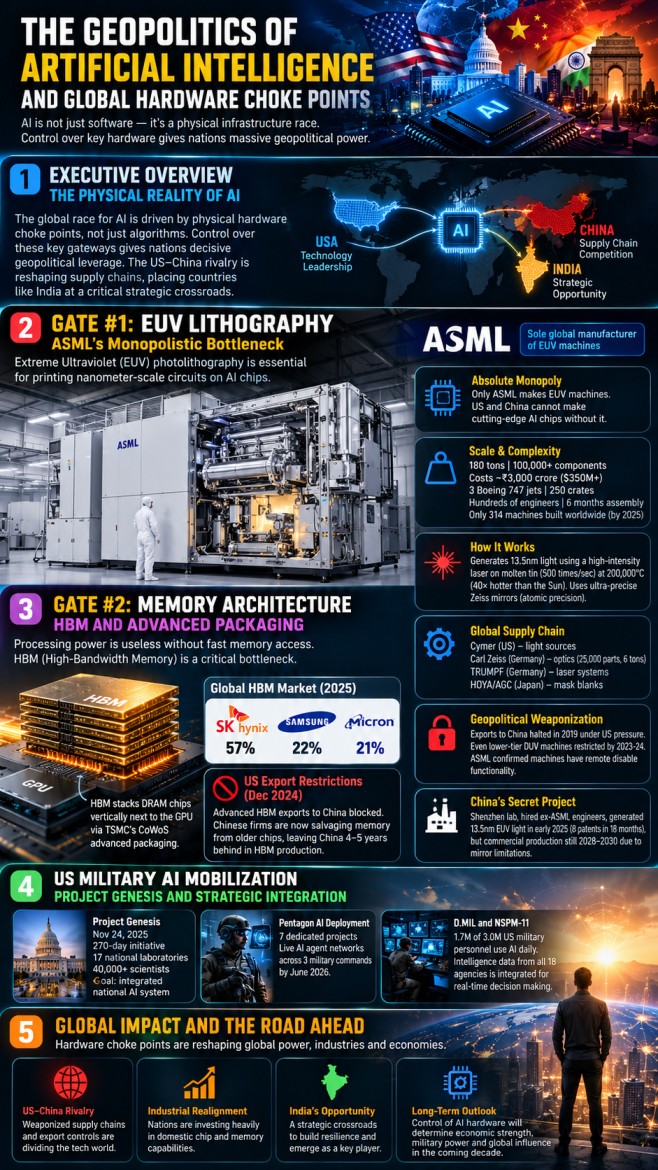
The global race for Artificial Intelligence (AI) dominance is frequently framed around algorithms, software, and cloud computing. However, artificial intelligence is fundamentally an infrastructure pipeline governed by physical hardware choke points. Controlling these key gateways grants nation-states decisive geopolitical leverage.
The technological landscape is experiencing a structural realignment driven by weaponized supply chains between the United States and China, placing non-aligned industrial powerhouses like India at a critical strategic crossroads.
1. Executive Overview: The Physical Reality of Artificial Intelligence
While public discussions spotlight frontier foundation models and generative chatbots, every single token of inference and parameter optimization relies on an uncompromising, fragile physical reality. Nanometer-precision optics, vertical silicon memory stacks, and refined rare earth elements form an interconnected physical hierarchy where a disruption at any single node halts global technological progress.
2. Gate #1: Extreme Ultraviolet (EUV) Lithography and ASML's Monopolistic Bottleneck
At the foundation of advanced chip manufacturing lies Extreme Ultraviolet (EUV) photolithography—the essential process for printing nanometer-scale circuits on AI microprocessors.
- ASML's Absolute Monopoly: Dutch enterprise ASML is the sole global manufacturer of commercial EUV photolithography systems. Neither the United States nor China can fabricate cutting-edge AI microprocessors independently without ASML hardware.
- Scale and Engineering Complexity: A single EUV machine weighs 180 tons, contains over 100,000 components, costs approximately ₹3,000 crore ($350 million+), and requires three Boeing 747 cargo jets and 250 crates for transport. Assembling the machine takes hundreds of specialized engineers over six months in hyper-cleanrooms. By 2025, only 314 EUV machines had been built worldwide.
- The Physics of Printing Nanometer Circuits: EUV machines generate 13.5-nanometer light by firing a high-intensity laser at molten tin droplets 500 times per second, converting them into plasma at 200,000°C—forty times hotter than the surface of the Sun. Light is converged using Carl Zeiss mirrors polished with atomic precision; if scaled to the geographical size of Germany, the highest surface bump on the mirror would measure under 0.1 millimeter.
- Specialized Global Ecosystem: ASML's machine relies on a deeply interdependent international supply chain: Cymer (US) for light sources, Carl Zeiss (Germany) for illumination optics (25,000 parts weighing 6 tons), TRUMPF (Germany) for laser systems, and HOYA/AGC (Japan) for mask blanks.
- Geopolitical Weaponization & Remote Kill-Switches: In 2018, the Netherlands granted ASML a license to export EUV machines to China, but halted exports in 2019 under intense US diplomatic pressure. By 2023–2024, multilateral export controls restricted even lower-tier Deep Ultraviolet (DUV) machines. ASML confirmed in May 2024 that sold EUV machines contain remote disable functionality that can be triggered from afar if needed.
- Shenzhen's Secret "Manhattan Project": In response, Beijing established an ultra-high-security lab in Shenzhen, hiring former ASML engineers under pseudonyms with multi-crore compensation packages. Utilizing machine components acquired via Alibaba auctions and front companies, Chinese engineers generated 13.5nm EUV light in early 2025 (filing 8 patents in 18 months). However, due to optical mirror limitations, commercial production of advanced chips remains delayed until at least 2028–2030.
3. Gate #2: Memory Architecture (HBM) and Advanced Packaging
Processing speed cannot function without rapid memory access, creating another critical physical bottleneck in AI compute.
- The Memory Choke Point: High-Bandwidth Memory (HBM) stacks DRAM chips vertically directly adjacent to the GPU via TSMC's Advanced Packaging (CoWoS). Without HBM, advanced AI processors are rendered inoperable.
- Market Monopolies: As of late 2025, three companies control the entire global HBM market: SK Hynix (57%), Samsung (22%), and Micron (21%).
- US Export Restrictions: In December 2024, Washington instituted strict export controls on advanced HBM to China, blocking South Korean manufacturers from supplying Chinese tech firms. Consequently, Chinese firms have resorted to salvaging memory from legacy chips, leaving China 4 to 5 years behind in HBM production.
4. US Military AI Mobilization: Project Genesis and Strategic Integration
The United States is mobilizing federal and defense resources to maintain technological dominance.
- Project Genesis: On November 24, 2025, President Donald Trump signed an executive order launching "Project Genesis"—a 270-day initiative explicit in its Manhattan Project-level ambition, uniting 17 national laboratories, 40,000+ scientists, and supercomputers to build an integrated national AI system.
- Pentagon AI Deployment: The US Department of Defense is deploying an AI-first warfighting force through seven dedicated projects, with live AI agent networks operational across three military commands by June 2026.
- D.MIL and NSPM-11: Over 1.7 million out of 3.0 million US military personnel interact with frontier AI models daily via the D.MIL platform. Under directive NSPM-11, intelligence data from the NSA and all US intelligence agencies is being integrated into a central super-intelligent AI architecture.
5. China's Counter-Weapon: Critical Mineral Monopolies and Export Restrictions
While Washington holds leverage over chip design and lithography machines, Beijing controls the critical raw materials required for electric motors, optical networks, and data center power systems.
- Beijing's Critical Mineral Monopoly: China controls 94% of global processing for Neodymium-Praseodymium (NdPr) permanent magnets used in electric vehicles, wind turbines, and data center cooling pumps. China also controls 98%–99% of Dysprosium/Terbium refining (magnet heat shields), 99% of Yttrium (jet engine turbine ceramic coatings), 95% of Erbium (fiber-optic signal amplifiers), and 98%–99% of Gallium (Gallium Nitride high-voltage power semiconductors).
- Environmental Sacrifice as a Barrier: China secured this monopoly by absorbing severe environmental degradation. In refining hubs like Baotou, toxic waste reservoirs and radioactive thorium contamination produced cancer clusters and forced village evacuations—an environmental cost Western nations avoided.
- Economic Asymmetry of Export Bans: China's raw material exports represent a $3 billion annual market. However, restricting them places an estimated $6.5 trillion in global manufacturing at risk, including over $1.5 trillion in the US and $1.5 trillion in Europe.
- Immediate Factory Disruptions: In May 2025, Ford Motor Company was forced to halt its Chicago Explorer assembly line due to a shortage of small neodymium motor magnets. In India, Maruti Suzuki reduced its EV production targets by two-thirds following Beijing's export restrictions on seven critical metals.
- The Critical Mineral Deadline: Following export controls on Gallium/Germanium in 2023 and Rare Earths in late 2025, China established a key decision point on November 10, 2026, to decide whether to permanently lock down or relax global critical mineral exports. This decision poses a direct operational threat to manufacturing plants across India, Europe, and North America.
6. The Bipolar World Order: Pax Silica vs. Waico
The global technological geopolitical landscape has bifurcated into two competing blocs: the US-led Pax Silica and the China-led Waico.
- Tiered AI Access: Washington has categorized nations into tiers: Tier 1 (inner circle with unlimited access), Tier 2 (capped AI infrastructure access, including India), and Tier 3 (restricted access).
- End of Non-Alignment: August 2026 policy directives from the US State Department make clear that non-alignment is no longer viable; countries must choose sides or risk losing access to advanced computing infrastructure.
7. India's Position, Strategic Realities, and Roadmap
India remains primarily a consumer of AI hardware rather than a foundational builder, but strategic avenues exist to gain supply chain leverage.
- Current Fabrication Reality: SCL Mohali operates at 180nm technology compared to the global leading edge of 2nm. Under SemiCon 2.0, India expects to receive 193nm DUV equipment first, with EUV adoption estimated between 2032 and 2035.
- Domestic Fab & OSAT Projects: The Tata-Powerchip partnership is constructing India's first commercial semiconductor fab in Dholera, Gujarat, utilizing 193nm DUV light for 124nm–180nm node chips. Micron's Sanand facility in Gujarat is conducting Assembly, Testing, and Packaging (OSAT) for DRAM and NAND memory.
- Major Global Infrastructure Commitments: Lam Research announced a ₹10,000 crore investment to build India's first semiconductor component manufacturing facility, while Applied Materials committed $5 billion (₹47,000 crore) under its Vision 2035 plan to scale India's semiconductor ecosystem.
- Strategic Roadmap—Controlling "Bottlenecks of Bottlenecks": India does not need to manufacture every end product, but can establish control over niche, indispensable inputs. A prime example is Japan's Ajinomoto, which holds over 95% market share in ABF (Ajinomoto Build-up Film)—an essential packaging film used in every Nvidia GPU, AMD server processor, and custom AI chip worldwide.
Key Indian Resource Initiatives
- Gallium Extraction: NALCO announced a 10-tonne annual Gallium extraction plant at its Damanjodi refinery, recovering Gallium as a byproduct of aluminum refining.
- Permanent Rare Earth Magnets: The Indian government approved a ₹7,280 crore scheme to produce 6,000 tonnes of permanent rare earth magnets annually from Kerala beach sands.
- Industrial Byproduct Gases: India, as the world's second-largest steel producer, possesses untapped potential to extract semiconductor-grade Neon, Krypton, and Xenon gases from steel production, as well as Germanium from zinc refining.
8. Strategic Conclusion
In modern geopolitical conflicts, power is asserted not through conventional weapons, but by locking down critical physical supply chain gateways. For India, achieving true strategic sovereignty requires transitioning from a passive consumer to an indispensable supplier of critical specialized inputs within the global AI hardware ecosystem.