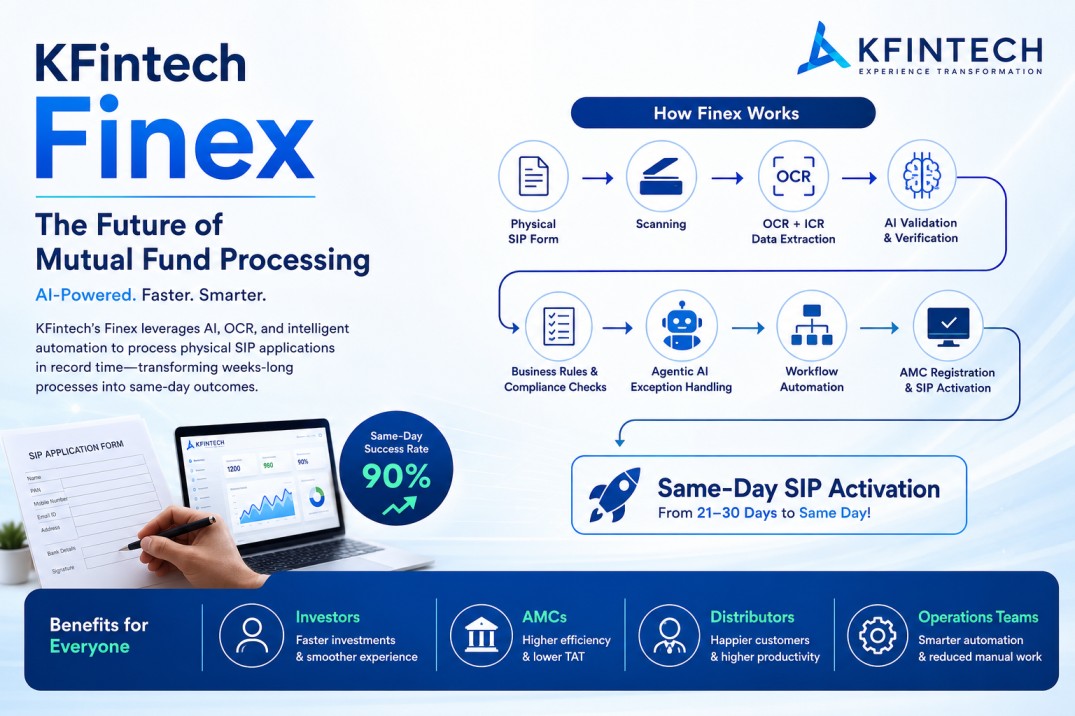
For years, registering a physical Systematic Investment Plan (SIP) in India often meant waiting several weeks before the first investment could begin. Paper forms, manual verification, banking checks, and multiple approval stages slowed the process. KFintech's Finex aims to change that.
In an era dominated by instant mobile payments and biometric logins, the Indian mutual fund industry still handles a surprisingly large volume of physical paperwork. Many retail investors in smaller cities, corporate entities, and legacy accounts rely on physical paper mandates. When these forms enter the operations pipeline, they trigger a chain of manual checks that can take anywhere from three weeks to a month. KFintech Finex was introduced to resolve this operational bottleneck, applying advanced Artificial Intelligence (AI) to transform physical documents into digital transactions almost instantly.
By leveraging computer vision, natural language processing, and automated decision-making workflows, KFintech is addressing one of the most stubborn speed bumps in the retail wealth management ecosystem. Finex represents a major milestone in digital transformation, shifting operational responsibilities from paper-shuffling and keyboard data entry to intelligent supervision and exception handling. This article provides a comprehensive exploration of KFintech Finex, analyzing its core mechanics, its underlying technologies, and its impact on the mutual fund landscape.
What is KFintech Finex?
It is important to clarify that KFintech Finex is not a standalone company. Rather, it is a proprietary, AI-powered enterprise workflow and automation platform developed, owned, and operated by KFin Technologies Limited (KFintech). KFintech is one of India's leading Registrar and Transfer Agents (RTAs), servicing dozens of mutual fund houses, hundreds of corporate issuers, and millions of investor folios.
RTA operations have historically been characterized by vast processing centers where data entry operators transcribe details from paper documents into core registry systems. Finex was introduced to automate this workflow. The platform acts as an intelligent processing hub. Instead of relying on manual transcription, it ingests scanned images of physical forms, extracts relevant text fields, runs real-time database validation queries, and registers the transaction directly.
Finex solves the operational challenges associated with physical SIP registration, One-Time Mandates (OTM) for banking debits, and investor KYC forms. By replacing slow, error-prone manual verification with automated document intelligence, the platform allows financial institutions to handle physical transactions with the same speed and efficiency as digital-first investments.
Did You Know?
Despite rapid digitization, a significant portion of Systematic Investment Plans (SIPs) in India's semi-urban and rural areas are still initiated via physical forms. This makes technologies like Finex essential for bridging the digital divide and driving financial inclusion.
Why Physical SIP Processing Was Traditionally Slow
To appreciate how AI changes the game, we must look at how physical SIP and OTM mandates were handled before modern automation. The traditional lifecycle of a physical mandate was a slow, multi-week journey involving multiple hands, logistics, and paper trails:
- Form Collection and Courier Logistics (3-7 Days): Investors fill out physical paper forms at a distributor's office or a local bank branch. These forms must be physically collected, sorted, boxed, and couriered to central RTA processing offices. Delays due to weather, transport issues, and geographic distance are common.
- Manual Sorting and Categorization (1-2 Days): Once the boxes of forms arrive at the operations facility, teams must manually open, sort, and categorize them by Asset Management Company (AMC), scheme type, and transaction type.
- Double-Blind Data Entry (2-3 Days): To prevent transcription errors, legacy operations rely on "double-blind" data entry. Two separate operations agents type the exact same form details into the database. If their entries match, the transaction is approved. If they mismatch, a supervisor must review the paper form to resolve the error. This process is slow, expensive, and prone to fatigue-driven errors.
- Manual Verification and KYC Verification (2-3 Days): Operations staff must check government databases to confirm the investor's PAN is valid, active, and KYC-compliant. They must also verify that bank details match the investor's name.
- Bank Mandate Registration (OTM Setup) (10-15 Days): The physical OTM form is scanned and uploaded to banking networks. Bank officers compare the signature on the form with their customer record, check details, and approve or reject the debit mandate. This step is a major bottleneck in the cycle.
Due to these sequential dependencies, registering a physical SIP traditionally took anywhere from 21 to 30 days. If a single digit was mistyped or a signature did not perfectly match, the form was rejected, and the entire multi-week cycle started over.
Comparison of Mandate Processing Lifecycles
| Processing Phase | Traditional Manual Process | KFintech Finex AI Process |
| Logistics | Physical shipping of forms to central offices (3-7 days) | Immediate local scanning & digital upload (Seconds) |
| Data Entry | Manual double-blind keyboard entry (Slow & prone to typos) | Automated OCR and ICR text extraction (Under 10 seconds) |
| Verification | Manual lookup in KYC, PAN, and IFSC directories | Instant API queries and cross-field checks via AI |
| Mandate Approval | Courier or legacy batch file uploads to banks (10-15 days) | Direct digital API communication with banks (Same day) |
| Turnaround Time | 21 - 30 Days | Same Day / Under 24 Hours |
How KFintech Finex Works
While the internal system details are proprietary to KFintech, we can outline a step-by-step processing workflow based on their public announcements and industry-standard enterprise automation practices:
The investor submits a paper mandate. The distributor scans the document locally using a high-speed scanner or mobile app. The high-resolution image is uploaded to the Finex secure cloud environment.
Before extracting text, image algorithms run auto-rotation, deskewing, and contrast adjustments. This removes wrinkles, shadows, and angle distortions to ensure high-fidelity character recognition.
The engine isolates pre-printed areas of the form (such as field labels, checkboxes, and terms) to establish layout positioning.
An Intelligent Character Recognition neural network reads the handwritten characters in the input fields (e.g., investor name, bank account number, and signature blocks), translating pen strokes into digital strings.
The extracted strings are cross-checked against third-party databases: PAN compliance with NSDL/CDSL registries, IFSC validity with banking databases, and KYC status.
The BRE runs validation checks on SIP timelines (e.g., ensuring the gap between registration and the first debit date is within regulatory limits) and confirms that the mandate limit covers the SIP amount.
If the AI model detects a low-confidence read (e.g., sloppy handwriting) or a validation mismatch, it flags it as an exception. This is routed to a human operations dashboard for rapid visual audit, bypass, or repair.
Verified mandates are pushed via API directly to the AMC database and bank integration systems, setting up the SIP schedule and triggering automated debit mandates.
Key Takeaway
By processing documents through this parallel, modular architecture, Finex eliminates the sequential bottlenecks that plague manual document verification workflows.
OCR Explained
To understand the tech behind Finex, we need to look at its core technologies, starting with Optical Character Recognition (OCR). OCR is a mature technology designed to translate scanned images of printed text into machine-encoded text.
When a document is scanned, the computer sees it as a grid of pixels (black, white, or color). It does not understand that a collection of pixels forms the letter "A" or the number "5". OCR algorithms search for shapes, lines, and borders in the image. By comparing these shapes to a database of known fonts and character metrics, the software translates the pixel grid into actual digital text.
You interact with OCR regularly in daily life:
- Mobile Banking Apps: Scanning the front of a credit card or reading a check using your smartphone camera.
- Invoice Processing: Systems reading vendor names, invoice numbers, and line items from PDF invoices.
- Passport Readers: Border control terminals scanning the Machine Readable Zone (MRZ) at airport security checkpoints.
In mutual funds, OCR is highly effective for reading printed labels and standardized static templates. However, physical application forms present a major limitation: the investor's unique, handwritten information. That is where ICR comes in.
ICR Explained
Intelligent Character Recognition (ICR) is the evolutionary successor to OCR. While traditional OCR reads printed fonts, ICR interprets handwritten text.
Reading human handwriting is one of the most complex challenges in computer vision. Unlike computer fonts, handwriting is highly irregular. No two people write letters the same way; even a single individual writes differently depending on the pen used, writing speed, or surface. Some letters loop, some are cursive, and spacing between characters varies widely.
ICR engines resolve this by utilizing deep neural networks. Instead of looking for static character matches, they look for structural features (strokes, loops, crossbars) and combine them with context-aware language models. For example, if the ICR engine reads a name field as "J-O-H-N S-M-1-T-H", the language model recognizes that "1" is mathematically out of place in a last name and corrects it to "I".
| Feature | OCR (Optical Character Recognition) | ICR (Intelligent Character Recognition) |
| Text Type Recognized | Machine-printed text and fonts (standardized styles) | Handwritten print, cursive, and unstructured text |
| Technology Basis | Matrix matching and basic pattern recognition | Deep learning, convolutional neural networks, and semantic models |
| Accuracy Factors | Affected by scan resolution and font styling | Affected by handwriting clarity, ink bleed, and stroke quality |
| Financial Use Case | Reading pre-printed form structures, legal terms, and IDs | Reading customer names, amounts, account numbers, and dates |
AI Validation
Once OCR and ICR have translated pixels into digital strings, the data must be validated. Simply reading the text is not enough; the system must verify that the information is correct and compliant with SEBI and AMFI regulations.
The AI validation layer inside Finex performs several automated checks:
- PAN & KYC Cross-Reference: The extracted PAN is verified against the Central Depository Services (CDSL) or National Securities Depository (NSDL) registry. The system confirms that the PAN is valid and active, and checks if the investor's KYC status is registered.
- Banking Data Validation: The bank account number and IFSC code are checked against central bank directories. The system verifies that the IFSC code is correct, active, and corresponds to the designated branch.
- Fuzzy Name Matching: It is common for names to vary slightly between different documents. For example, a form might list "Shubham Paul", while the PAN database lists "Shubham Kumar Paul". Finex uses fuzzy string-matching algorithms (such as Levenshtein distance) to calculate a confidence score, validating the match if it meets compliance thresholds.
- Form Completeness Check: The engine scans the entire document to ensure no mandatory fields (such as signature, date, or amount) are blank, flagging incomplete forms instantly before they can progress.
What is Agentic AI?
Standard automation is rule-based: "If X happens, perform Y." It cannot handle ambiguity. Agentic AI represents a paradigm shift where AI is designed to act as an autonomous agent. Instead of following a rigid, linear script, an Agentic AI system is given a goal and is empowered to plan, execute, and verify its actions to achieve that goal.
In mutual fund processing, an AI agent does not just extract text; it actively verifies the data. For example, if a signature is slightly cut off in the scanned image, a traditional OCR tool fails. An Agentic AI, however, can analyze the issue, identify the cause, query historical documents for the same folio, compare signatures across previous transactions, and decide whether it is safe to approve the document or if it requires human review. It acts with intent and context, operating like a digital compliance assistant.
Example Case
Imagine an investor writes "KFintech" instead of "KFin Technologies" on an application form. A rigid programmatic check might reject this. An Agentic AI system understands the context, recognizes the abbreviation, matches it with the database, and processes the application without delays.
Workflow Automation
Document digitization is only half the battle. Once data is verified, it must move through the processing pipeline. Finex replaces the manual handoffs of traditional operations with a modern workflow automation engine:
Traditional operations teams rely on serial processing. Files move from sorting to data entry, then to KYC checking, and finally to banking upload. This linear progression is slow, as delays at any step stall the entire pipeline.
Finex uses parallel processing. The moment a form is scanned, components are divided and processed simultaneously:
- The KYC check runs on the extracted PAN.
- The bank mandate is sent to the banking API.
- The signature block is isolated and compared to historical records.
All these steps occur concurrently in the background, slashing overall processing times from weeks to minutes.
Exception Handling
No AI system is perfect. Extreme handwriting variations, illegible ink, folded paper lines, or missing fields will inevitably occur. These are classified as exceptions.
Instead of stalling the pipeline, Finex routes these flagged cases to human operators through an intuitive exception dashboard. The interface shows the scanned form side-by-side with the AI's reading, highlighting the problem areas. The human operator can quickly verify the handwritten details, make the correction, and click submit. This Human-in-the-Loop (HITL) approach ensures that technology and human expertise work together, maintaining high processing speed without compromising accuracy or security.
Benefits for Investors
For retail investors, the primary benefit is speed. Instead of waiting weeks to see their first mutual fund investment active, they can have their physical SIP mandate registered and confirmed on the same day. This minimizes market entry delay and ensures they do not miss planned investment cycles.
Benefits for Mutual Fund Companies
AMCs benefit from reduced operating costs. Manual processing is expensive, requiring large teams, physical storage facilities, and complex shipping logistics. By digitizing documents locally, AMCs save on overhead. Faster processing also improves investor conversion rates, as long activation delays often lead to buyer's remorse and cancelled mandates.
Benefits for Distributors
Mutual fund distributors and financial advisors benefit from fewer rejected applications. By identifying errors like missing signatures or invalid IFSC codes during the scanning phase, they can resolve issues with clients immediately, rather than waiting weeks for a rejection notice to arrive.
Benefits for Operations Teams
It is a common misconception that AI is introduced to eliminate jobs. In reality, automation changes the nature of work. By automating repetitive, low-value data entry, operations teams transition from manual typists to data verifiers and exception managers.
This shift allows operations professionals to develop skills in data analysis, exception troubleshooting, and system oversight. They move away from monotonous data entry to focus on high-priority compliance audits, fraud prevention, and resolving complex client issues.
| Stakeholder Group | Key Benefits Delivered by Finex | Net Impact |
| Investors | Same-day processing, faster investment setup, reduced risk of missing dates | Better Investment Experience |
| AMCs (Fund Houses) | Reduced processing overhead, lower rejection rates, improved regulatory compliance | Higher Operational Efficiency |
| Distributors | Fewer client complaints, real-time status updates, faster commission cycles | Accelerated Onboarding |
| Operations Teams | Shift from manual entry to exception verification and risk oversight | Upskilling & Professional Growth |
Can AI Replace Mutual Fund Operations Jobs?
A balanced answer is no. While AI is highly efficient, it operates within strict limits. AI lacks human judgment, empathy, and contextual understanding.
Financial processing involves complex compliance decisions and regulatory oversight. When a unique document case or an edge-case compliance conflict arises, an AI cannot make policy decisions. Humans are essential for oversight, ensuring that automated systems operate correctly and comply with SEBI and AMFI regulations. Finex does not replace humans; instead, it empowers them to work faster and focus on high-value tasks.
Future of Mutual Fund Processing
The success of platforms like KFintech Finex signals a broader shift toward hyper-automation in wealth management. As AI models evolve, the line between physical and digital documents will blur.
We can expect predictive analytics engines that anticipate document rejection rates before a form is submitted. Real-time edge validation will allow distributors to scan forms on mobile devices, with AI running instant checks to confirm validity before the client leaves the office. The future of mutual funds is not just digital; it is smart, autonomous, and friction-free.